Indian Penal Code, 1860

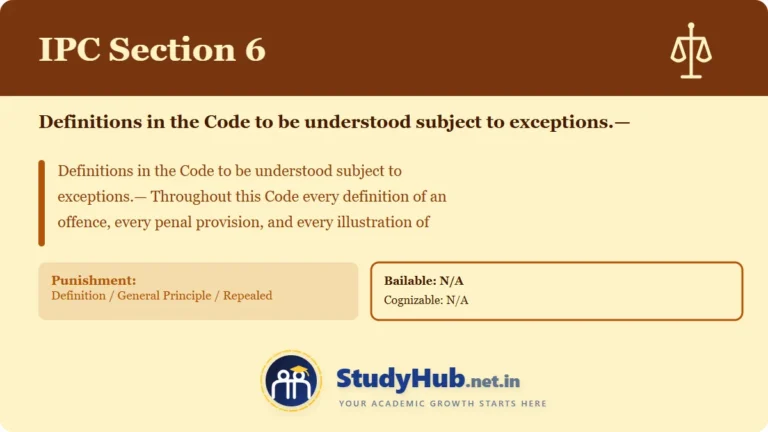
Definitions in the Code to be understood subject to exceptions.—

Section

6

Punishment

Definition / General Principle / Repealed

Cognizable

N/A

Bailable

N/A

Compoundable

Non-Compoundable (Refer to CrPC 320 for exceptions)

Trial Court

N/A

Bare Act Text

6. Definitions in the Code to be understood subject to exceptions.— Throughout this Code every definition of an offence, every penal provision, and every illustration of every such definition or penal provision, shall be understood subject to the exceptions contained in the Chapter entitled “General Exceptions”, though those exceptions are not repeated in such definition, penal provision, or illustration.Illustrations(a)The sections, in this Code, which contain definitions of offences, do not express that a child under seven years of age cannot commit such offences, but the definitions are to be understood subject to the general exception which provides that nothing shall be an offence which is done by a child under seven years of age.(b)A, a police-officer, without warrant, apprehends Z, who has committed murder. Here A is not guilty of the offence of wrongful confinement; for he was bound by law to apprehend Z and therefore the case falls within the general exception which provides that “nothing is an offence which is done by a person who is bound by law to do it”.
According to the official bare act, this legal offense is defined as: 6. Definitions in the Code to be understood subject to exceptions.— Throughout this Code every definition of an offence, every penal provision, and every illustration of every such definition or penal provision, shall be understood subject to the exceptions contained in the Chapter entitled “General Exceptions”, though those exceptions are not repeated in such definition, penal provision, or illustration.Illustrations(a)The sections, in this Code, which contain definitions of offences, do not express that a child under seven years of age cannot commit such offences, but the definitions are to be understood subject to the general exception which provides that nothing shall be an offence which is done by a child under seven years of age.(b)A, a police-officer, without warrant, apprehends Z, who has committed murder. Here A is not guilty of the offence of wrongful confinement; for he was bound by law to apprehend Z and therefore the case falls within the general exception which provides that “nothing is an offence which is done by a person who is bound by law to do it”.
The punishment for this specific offense is outlined under the law as: Definition / General Principle / Repealed
Under the Indian Penal Code, this specific offense is classified as a N/A offense.
The legal status regarding police arrest without a warrant is that this offense isN/A.
Cases pertaining to this specific IPC section are triable by the N/A.
The compoundable nature of this offense, meaning whether the parties can settle it out of court, is classified as: Non-Compoundable (Refer to CrPC 320 for exceptions).

Leave a Comment

Scroll to Top