Indian Penal Code, 1860
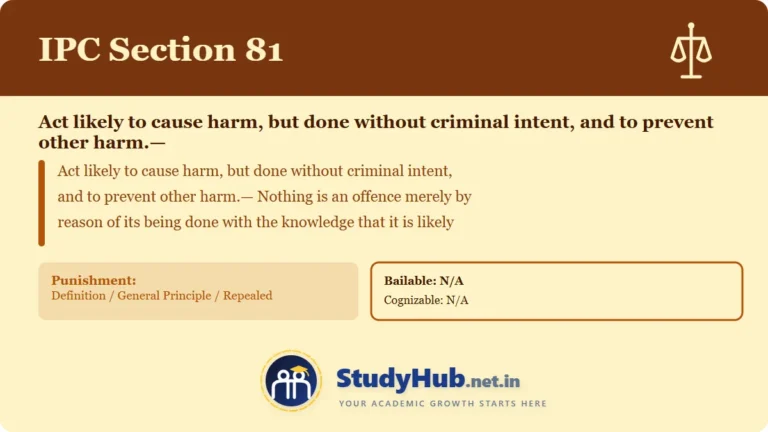
Act likely to cause harm, but done without criminal intent, and to prevent other harm.—
Section
81
Punishment
Definition / General Principle / Repealed
Cognizable
N/A
Bailable
N/A
Compoundable
Non-Compoundable (Refer to CrPC 320 for exceptions)
Trial Court
N/A
Bare Act Text
81. Act likely to cause harm, but done without criminal intent, and to prevent other harm.—
Nothing is an offence merely by reason of its being done with the knowledge that it is likely to cause harm, if it be done without any criminal intention to cause harm, and in good faith for the purpose of preventing or avoiding other harm to person or property.Explanation.— It is question of fact in such a case whether the harm to be prevented or avoided was of such a nature and so imminent as to justify or excuse the risk of doing the act with the knowledge that it was likely to cause harm.Illustrations(a)A, the captain of a steam vessel, suddenly and without any fault or negligence on his part, finds himself in such a position that, before he can stop his vessel, he must inevitably run down to boat B, with twenty or thirty passengers on board, unless he changes the course of his vessel, and that, by changing his course, he must incur risk of running down a boat C with only two passengers on board, which he may possibly clear. Here, if A alters his course without any intention to run down the boat C and in good faith for the purpose of avoiding the danger to the passengers in the boat B, he is not guilty of an offence, though he may run down the boat C by doing an act which he knew was likely to cause that effect, if it be found as a matter of fact that the danger which he intended to avoid was such as to excuse him in incurring the risk of running down the boat C.(b)A, in a great fire, pulls down houses in order to prevent the conflagration from spreading. He does this with the intention in good faith of saving human life or property. Here, if it be found that the harm to be prevented was of such a nature and so imminent as to excuse A’s act. A is not guilty of the offence.
What is IPC Section 81 ?
According to the official bare act, this legal offense is defined as: 81. Act likely to cause harm, but done without criminal intent, and to prevent other harm.—
Nothing is an offence merely by reason of its being done with the knowledge that it is likely to cause harm, if it be done without any criminal intention to cause harm, and in good faith for the purpose of preventing or avoiding other harm to person or property.Explanation.— It is question of fact in such a case whether the harm to be prevented or avoided was of such a nature and so imminent as to justify or excuse the risk of doing the act with the knowledge that it was likely to cause harm.Illustrations(a)A, the captain of a steam vessel, suddenly and without any fault or negligence on his part, finds himself in such a position that, before he can stop his vessel, he must inevitably run down to boat B, with twenty or thirty passengers on board, unless he changes the course of his vessel, and that, by changing his course, he must incur risk of running down a boat C with only two passengers on board, which he may possibly clear. Here, if A alters his course without any intention to run down the boat C and in good faith for the purpose of avoiding the danger to the passengers in the boat B, he is not guilty of an offence, though he may run down the boat C by doing an act which he knew was likely to cause that effect, if it be found as a matter of fact that the danger which he intended to avoid was such as to excuse him in incurring the risk of running down the boat C.(b)A, in a great fire, pulls down houses in order to prevent the conflagration from spreading. He does this with the intention in good faith of saving human life or property. Here, if it be found that the harm to be prevented was of such a nature and so imminent as to excuse A’s act. A is not guilty of the offence.
What is the punishment for Dhara 81 ?
The punishment for this specific offense is outlined under the law as: Definition / General Principle / Repealed
Is IPC 81 bailable or non-bailable?
Under the Indian Penal Code, this specific offense is classified as a N/A offense.
Is Dhara 81 a cognizable offense?
The legal status regarding police arrest without a warrant is that this offense isN/A.
Which court has the jurisdiction to try IPC 81 cases?
Cases pertaining to this specific IPC section are triable by the N/A.
Can IPC Section 81 be compromised (Compoundable)?
The compoundable nature of this offense, meaning whether the parties can settle it out of court, is classified as: Non-Compoundable (Refer to CrPC 320 for exceptions).
Pramod Editor-in-Chief
Pramod is the Founder and Editor-in-Chief of StudyHub. He holds a Master's degree and is currently pursuing a Ph.D. in Geology, alongside more than 7+ years spent building and verifying competitive exam content for Indian aspirants. He leads StudyHub's editorial process across Indian Polity, the Constitution, Indian Economy, History, Geography, Science, and the platform's other subject areas — checking every article against primary sources (bare act text and Gazette notifications for constitutional topics, government and Economic Survey data for economy content, standard reference material elsewhere) and flagging it for re-verification whenever a relevant amendment, policy, or data update makes an earlier version outdated.