Indian Penal Code, 1860

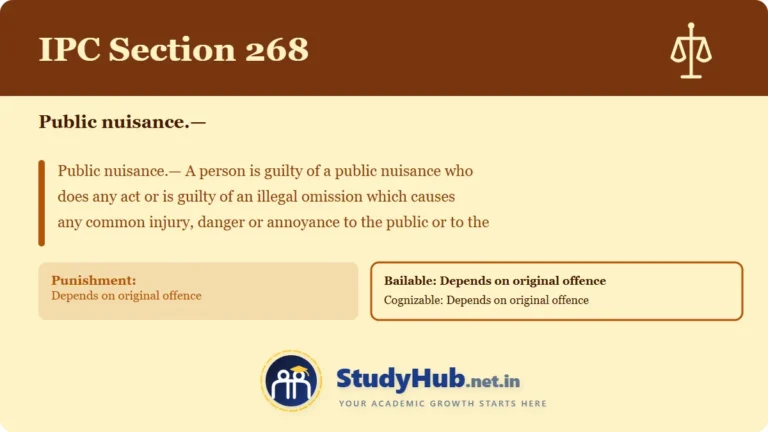
Public nuisance.—

Section

268

Punishment

Depends on original offence

Cognizable

Depends on original offence

Bailable

Depends on original offence

Compoundable

Non-Compoundable (Refer to CrPC 320 for exceptions)

Trial Court

Depends on original offence

Bare Act Text

268. Public nuisance.— A person is guilty of a public nuisance who does any act or is guilty of an illegal omission which causes any common injury, danger or annoyance to the public or to the people in general who dwell or occupy property in the vicinity, or which must necessarily cause injury, obstruction, danger or annoyance to persons who may have occasion to use any public right.A common nuisance is not excused on the ground that it causes some convenience or advantage.
According to the official bare act, this legal offense is defined as: 268. Public nuisance.— A person is guilty of a public nuisance who does any act or is guilty of an illegal omission which causes any common injury, danger or annoyance to the public or to the people in general who dwell or occupy property in the vicinity, or which must necessarily cause injury, obstruction, danger or annoyance to persons who may have occasion to use any public right.A common nuisance is not excused on the ground that it causes some convenience or advantage.
The punishment for this specific offense is outlined under the law as: Depends on original offence
Under the Indian Penal Code, this specific offense is classified as a Depends on original offence offense.
The legal status regarding police arrest without a warrant is that this offense isDepends on original offence.
Cases pertaining to this specific IPC section are triable by the Depends on original offence.
The compoundable nature of this offense, meaning whether the parties can settle it out of court, is classified as: Non-Compoundable (Refer to CrPC 320 for exceptions).

Leave a Comment

Scroll to Top