Soil is Earth’s most precious geological resource — the thin layer of life-supporting material between rock and sky that makes terrestrial life possible. It is not merely “dirt”; soil is a complex, dynamic system of minerals, organic matter, water, air, and billions of living organisms. Its formation — pedogenesis — is a slow geological process taking hundreds to thousands of years to produce even a few centimetres of topsoil. India’s extraordinary diversity of climate, geology, and vegetation has produced 8 major soil types ranging from the incredibly fertile alluvial soils of the Ganga plains to the mineral-rich Regur (Black Cotton) soil of the Deccan, the ancient red soils of the peninsular plateau, and the brick-like laterites of Kerala and the Western Ghats. Understanding soil formation, soil horizons, and the distribution of India’s soil types is essential for UPSC, SSC, Class 10–11 NCERT Geography, Agriculture, and Environmental Science examinations.
What is Soil? — Definition & Composition
- 🌱 Definition: Soil = the uppermost layer of Earth’s crust, formed by the weathering of parent rock + decomposition of organic matter, capable of supporting plant growth
- 🔬 Ideal soil composition (by volume): Minerals ~45% + Organic matter ~5% + Water ~25% + Air ~25%
- ⏱️ Formation rate: ~1 cm of topsoil takes 200–1,000 years to form; 30cm of productive topsoil = up to 10,000 years; soil is a non-renewable resource on human timescales
- 🌍 Importance: 95% of global food is produced from soil; Indian agriculture feeds 1.4+ billion people; soil erosion = one of India’s biggest environmental challenges
Factors of Soil Formation — CLORPT
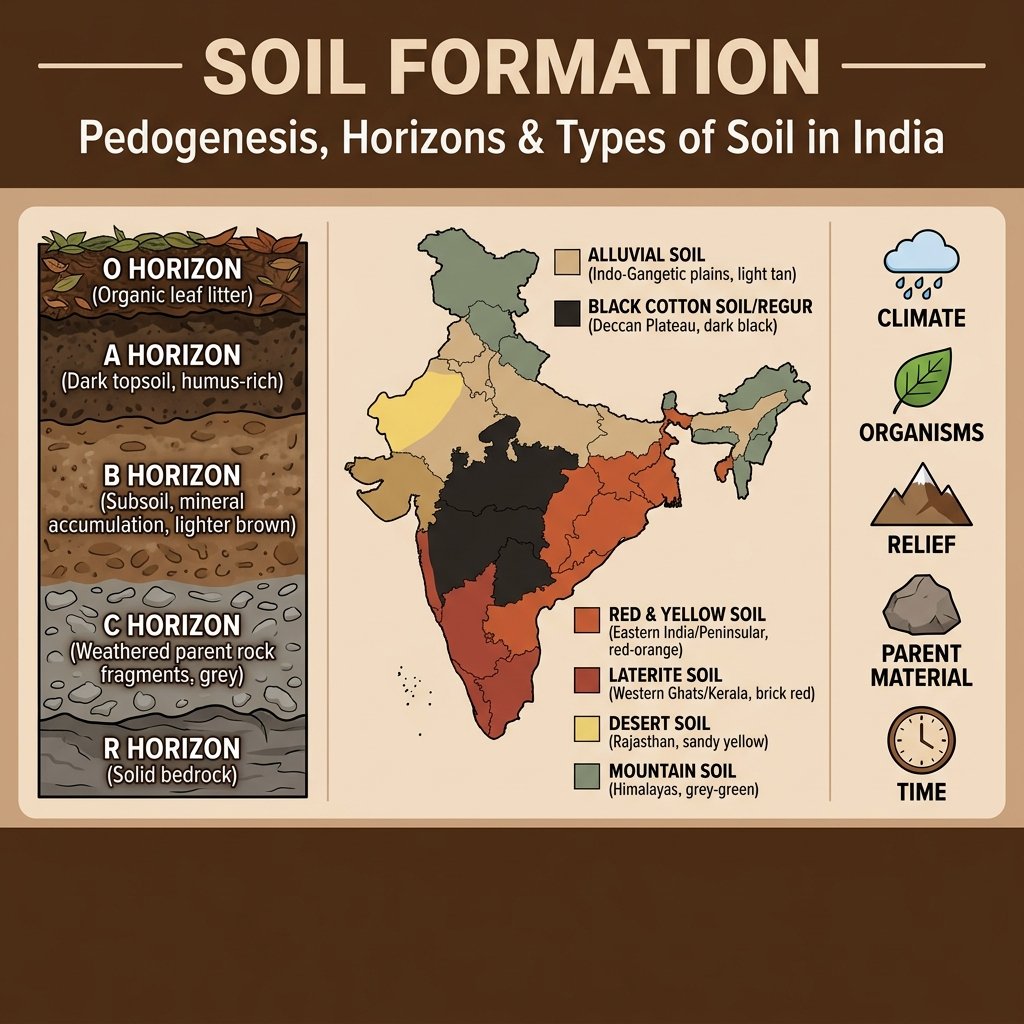
Hans Jenny (1941) identified five fundamental soil-forming factors, remembered by the acronym CLORPT:
| Factor | How It Affects Soil | Indian Example |
|---|---|---|
| C — Climate | Most important factor. Temperature controls weathering rates + decomposition speed. Rainfall controls leaching, erosion, and mineral dissolution. Hot+humid = rapid chemical weathering + leaching = laterite soils. Hot+dry = slow weathering, mineral accumulation = desert soils. | Kerala (high rainfall+heat) = laterite; Rajasthan (low rainfall+heat) = desert/arid soil; Himalayan foothills (high rainfall) = mountain soils |
| O — Organisms | Plants add organic matter (humus) from decaying roots + leaves = increases fertility + water retention. Bacteria decompose organic matter → nutrients. Earthworms mix + aerate soil. Fungi form mycorrhizal networks. Organisms accelerate weathering through root acids and burrowing. | Dense forest = humus-rich dark mountain soils; sparse desert vegetation = low organic matter; deep black cotton soil = historically grass-covered; microorganism diversity highest in tropical soils |
| R — Relief (Topography) | Slope controls water runoff vs infiltration. Steep slopes = rapid runoff + erosion = thin soils. Flat plains = water infiltrates + accumulates sediment = thick fertile soils. Valley bottoms collect eroded material = most fertile. Aspect (N vs S facing) affects temperature + moisture. | Ganga plains (flat) = deep alluvial soils; Himalayan slopes = thin mountain soils; river deltas = extremely fertile young soils; Deccan plateau (flat) = thick black cotton soil |
| P — Parent Material | The original rock being weathered controls mineral composition. Limestone → calcium-rich soils. Basalt → clay-rich, mineral-rich black soils. Granite/gneiss → sandy, low-fertility red soils. Sand → sandy soils. River sediment → fertile alluvial soils. | Deccan Trap basalt → Black Cotton Soil (Regur); Gondwana granite/gneiss → red soils of Jharkhand/Odisha; Himalayan river sediments → Ganga alluvial; coastal sand → sandy soils |
| T — Time | Older soils are more weathered, leached, and developed. Young soils (Entisols) = little differentiation, close to parent rock. Old soils (Ultisols, Oxisols/Laterites) = highly leached, nutrient-poor, all bases removed. Time needed for mature soil profile: 1,000–100,000+ years. | Ganga plain alluvial = relatively young (khadar = new; bhangar = old alluvial); South Indian laterites = ancient, highly weathered; Himalayan mountain soils = geologically young; peninsular red soils = very ancient (Precambrian parent rocks) |
Soil Horizons — The Soil Profile
A vertical cross-section through soil from surface to parent rock is called a soil profile. Each distinct layer is a horizon. A mature soil profile shows clear differentiation into horizons — immature soils show few or no distinct horizons.
| Horizon | Name | Description | Key Features |
|---|---|---|---|
| O | Organic horizon | Leaf litter, dead plant material, partially decomposed organic matter at soil surface | Not always present; thick in forests; absent in deserts and croplands; source of humus-forming material |
| A | Topsoil | Mineral soil + maximum organic matter (humus); darkest horizon; most biologically active | Most fertile layer; contains most plant nutrients, earthworms, bacteria; eroded most easily; key agricultural layer |
| E | Eluviation horizon | Leaching zone; fine clay particles, iron, and aluminium washed downward by water | Light-coloured (silica-rich, iron/clay removed); distinct in humid forests; absent in arid soils |
| B | Subsoil / Illuviation | Zone of accumulation; materials leached from A and E horizons deposit here (clay, iron oxides, calcite, organic matter) | Often reddish-brown (iron accumulation); may form dense clay layer (argillic horizon) or hard calcrete pan; less fertile than A horizon |
| C | Saprolite / Parent material | Partially weathered parent rock; loose, fragmented; retains original rock structure | Transitional between soil and rock; provides minerals to overlying horizons; not true soil yet |
| R | Bedrock | Unweathered solid parent rock | Bottom of soil profile; limestone, granite, basalt, sandstone etc. depending on location |
💡 Memory trick: O-A-E-B-C-R = “Old Age Eventually Brings Complete Rest” — from surface to bedrock.
Soil Processes — What Happens Inside Soil
- 💧 Leaching — downward movement of soluble minerals (calcium, magnesium, potassium, clay particles) through the soil profile by water; produces E horizon; intense in humid tropical regions (laterisation extreme leaching)
- 🔴 Laterisation — extreme leaching in hot, humid tropical climates; ALL soluble minerals removed; only insoluble iron and aluminium hydroxides remain; produces brick-red, hardening laterite; India’s Kerala, Western Ghats
- 🟤 Calcification — in arid/semi-arid regions; limited rainfall = incomplete leaching; calcium carbonate (CaCO₃ = calcrete/kankar) accumulates in B-horizon as calcareous nodules; Rajasthan and semi-arid zones
- ⬇️ Illuviation — accumulation in B-horizon of materials moved from above (clay particles, iron, humus); forms dense clay-rich (argillic) subsoil
- 🖤 Humification — decomposition of plant and animal residues by microorganisms into stable dark organic compounds (humus); increases soil fertility, water retention, and structure
- 🔄 Gleisation — waterlogged anaerobic conditions; iron reduced to ferrous (Fe²⁺) form giving grey-blue-green colour (gley colours); seen in swamp/waterlogged soils
- 🐛 Bioturbation — mixing of soil by organisms (earthworms, burrowing animals, plant roots, insects); improves soil structure and aeration
Types of Soil in India — ICAR Classification
The Indian Council of Agricultural Research (ICAR) classifies India’s soils into 8 major types based on origin, composition, and properties:
1. Alluvial Soil — India’s Most Fertile
- 📍 Distribution: Indo-Gangetic Plain (Punjab, Haryana, UP, Bihar, WB), river valleys throughout India, coastal plains; covers ~43% of India’s total land area — largest soil type
- 🌾 Origin: Deposited by rivers (Ganga, Yamuna, Brahmaputra, Mahanadi, Krishna, Godavari, Cauvery) carrying material eroded from Himalayas and peninsular plateau
- 🧪 Properties: Varies from sandy loam to silty clay; rich in potash, phosphoric acid; deficient in nitrogen and humus; pH near neutral (6.5–7.5); excellent water-retention capacity in finer varieties
- 🌱 Crops: Wheat, rice, sugarcane, cotton, jute, oilseeds — India’s breadbasket soils
- 🔑 Two types (age-based):
- Khadar = new alluvium; lighter in colour; finer texture; more fertile; deposited in floodplains (flooded every monsoon); found closer to rivers
- Bhangar = old alluvium; darker; coarser; contains calcareous concretions (kankar = CaCO₃ nodules); found on higher ground above floodplain; older deposits
2. Black Soil (Regur / Black Cotton Soil / Vertisol)
- 📍 Distribution: Deccan Plateau = Maharashtra (most), Gujarat, MP, Karnataka, AP/Telangana, some parts of TN; covers ~16% of India
- 🌋 Origin: Weathering of Deccan Trap basalt lava; the montmorillonite clay minerals produced from basalt weathering are highly expansive
- 🧪 Properties: Dark black to grey-black colour (from titaniferous magnetite mineral in basalt); very high clay content (montmorillonite/smectite); self-ploughing = shrinks in dry season (wide cracks open, loose material falls in), swells in wet season (cracks close); excellent moisture retention = stores water long after rains stop; rich in calcium, magnesium, potassium, iron; deficient in nitrogen, phosphorus, organic matter; slightly alkaline (pH 7.5–8.5)
- 🌱 Crops: Cotton (best — hence “Black Cotton Soil”), sugarcane, soybean, sunflower, wheat, pulses; Maharashtra = India’s #1 cotton state partly because of this soil
- ⚠️ Challenge: Sticky when wet → heavy machinery sinks; hard when dry → difficult to till; the self-ploughing action can damage plant roots
3. Red & Yellow Soil
- 📍 Distribution: Peninsular India — Odisha, Jharkhand, Chhattisgarh, eastern MP, parts of AP, Karnataka, Tamil Nadu; covers ~18% of India
- 🔴 Origin: Weathering of ancient crystalline and metamorphic rocks (gneiss, schist, granite) of the Peninsular plateau under low rainfall
- 🧪 Properties: Red colour from iron oxide (haematite) diffused through soil; yellow when hydrated (goethite = hydrated iron oxide); coarse texture; porous; low water retention; low clay content; deficient in nitrogen, phosphorus, humus; slightly acidic (pH 6–7)
- 🌱 Crops: With irrigation — rice, wheat, sugarcane, groundnut, pulses; rain-fed — coarse cereals (jowar, bajra), millets
- 🔑 Memory: Red = iron oxide; found where ancient hard rock + moderate rainfall; eastern/southeastern India
4. Laterite Soil
- 📍 Distribution: Western Ghats (Kerala, Karnataka coastal), Eastern Ghats, Meghalaya, Odisha, Maharashtra coastal, TN hills; covers ~3.7% of India
- 🌧️ Origin: Laterisation in high-rainfall, high-temperature areas; intense leaching removes all soluble minerals; only insoluble iron (Fe) and aluminium (Al) hydroxides remain — makes up the hardening red-brick material
- 🧪 Properties: Brick-red colour; very high iron and aluminium oxide content; hardens on exposure to air (laterite = Latin later = brick); nutrient-poor; acidic (pH 5–6); porous; poor water retention; humus rapidly destroyed by microbes in hot humid conditions
- 🏗️ Special use: Laterite blocks used as construction material (traditional Kerala/Goa buildings cut from laterite outcrops — soft when freshly cut, hardens on exposure)
- 🌱 Crops: Poor fertility but suitable for: cashew nuts, tea, coffee, rubber (plantation crops that don’t need rich soil); not good for food crops without heavy fertilisation
- 🔑 Memory: Laterite = brick = Kerala/Western Ghats = tea, coffee, rubber; formed by intense leaching of ALL nutrients
5. Arid / Desert Soil
- 📍 Distribution: Rajasthan (Thar Desert), parts of Gujarat (Rann of Kutch), Haryana, Punjab semi-arid zones; ~7% of India
- ☀️ Origin: Formed under extremely dry conditions (<250mm rainfall/year); minimal weathering; wind-deposited sand; chemical weathering limited
- 🧪 Properties: Sandy texture; porous (water drains rapidly); low organic matter; high salinity in some areas (salt accumulation from evaporation); rich in soluble salts, calcium carbonate, and phosphates (not leached); alkaline (pH 8–9); can be made productive with irrigation (Indira Gandhi Canal transformed parts of Rajasthan)
- 🌱 Crops (with irrigation): Wheat, cotton, millets (bajra), mustard, cumin (jeera)
6. Saline & Alkaline Soil (Usar / Reh / Kalar)
- 📍 Distribution: Arid/semi-arid areas — western Rajasthan, Gujarat (Rann of Kutch), UP (Agra, Mathura district), Haryana, Punjab; also in waterlogged delta areas
- 🧂 Origin: Capillary action brings soluble salts (sodium chloride, sodium sulphate) to surface as water evaporates; in deltas → seawater intrusion; over-irrigation without drainage → salinity build-up
- 🧪 Properties: White salt crusts on surface; high sodium content (sodic/alkaline soils); pH >8.5; poor fertility; plant growth inhibited by high salt concentration (osmotic stress)
- 🔧 Reclamation: Leaching (flooding + draining to wash out salts), adding gypsum (CaSO₄ replaces Na in soil → Na₂SO₄ leaches away), proper drainage systems
7. Peaty & Marshy Soil
- 📍 Distribution: Kerala (Kottayam, Alappuzha backwaters), parts of Odisha-WB coastal, Sundarbans delta, Uttarakhand
- 🌿 Origin: Accumulation of organic matter in waterlogged conditions; incomplete decomposition of vegetation (anaerobic conditions prevent full breakdown)
- 🧪 Properties: Very dark black/brown; very high organic content; acidic; waterlogged; rich in humus but nutrients locked in organic form; heavy (high water content)
- 🌱 Crops: Rice (paddy) — Kerala’s famous Kuttanad fields (farming below sea level using embankments); once drained → highly fertile
8. Forest & Mountain Soil
- 📍 Distribution: Himalayan region (J&K, HP, Uttarakhand, NE India), Western Ghats forests, Eastern Ghats forested areas; ~8% of India
- 🌲 Origin: Formed under forest cover on mountain slopes; varied parent rock; high rainfall; large leaf-litter input
- 🧪 Properties: Rich in humus (from dense forest leaf fall); loamy to sandy loam texture; acidic (from organic acids from leaves); thin on steep slopes; deeper in valleys; fertile where humus is thick
- 🌱 Crops: Tea (Darjeeling, Assam), coffee, spices, orchards (apple in HP, Uttarakhand); not suitable for heavy ploughing (steep slopes, thin soil)
Summary Comparison — India’s 8 Soil Types
| Soil Type | Parent Material | Colour | Key States | Best Crops | Key Challenge |
|---|---|---|---|---|---|
| Alluvial | River sediments (Himalayan) | Light to dark grey | UP, Punjab, Bihar, WB | Wheat, Rice, Sugarcane | N deficiency; needs fertiliser |
| Black/Regur | Deccan Trap basalt | Deep black | Maharashtra, Gujarat, MP | Cotton, Soybean | Sticky when wet, hard when dry |
| Red & Yellow | Crystalline/metamorphic rocks | Red/yellow | Odisha, Jharkhand, AP | Millets, Groundnut | Low moisture retention, low fertility |
| Laterite | Intensely weathered any rock | Brick red | Kerala, W. Ghats, Meghalaya | Tea, Coffee, Rubber | Very poor nutrients; highly acidic |
| Arid/Desert | Wind-blown sand | Sandy yellow/grey | Rajasthan, Gujarat | Bajra, Mustard (irrigated) | Water scarcity; high salinity |
| Saline/Alkaline | Salt accumulation (evaporation) | White crust | Rajasthan, UP, Haryana | Very limited without reclamation | High Na, plant osmotic stress |
| Peaty/Marshy | Organic matter accumulation | Very dark black | Kerala, Odisha coast, Sundarbans | Rice (Kuttanad) | Waterlogged; nutrients locked |
| Forest/Mountain | Varied, under forest cover | Dark (humus) to grey | Himalayas, W. Ghats | Tea, Apple, Spices | Thin on slopes; prone to erosion |
⭐ Important for Exams — Quick Revision
- 🔑 CLORPT = Climate (most important), Organisms, Relief, Parent material, Time — 5 soil-forming factors
- 🔑 Soil profile horizons: O (litter) → A (topsoil, most fertile) → E (leached) → B (subsoil, accumulation) → C (weathered rock) → R (bedrock)
- 🔑 Alluvial soil = largest type (~43% India); Indo-Gangetic Plain; Khadar (new, lighter, more fertile) vs Bhangar (old, kankar nodules)
- 🔑 Black/Regur soil = from Deccan Trap basalt; self-ploughing (shrinks + swells); best for cotton; Maharashtra, Gujarat, MP
- 🔑 Red soil = iron oxide (haematite) = red colour; from crystalline rocks; Peninsular India (Odisha, Jharkhand, AP)
- 🔑 Laterite soil = formed by laterisation (extreme leaching); Kerala, Western Ghats; used as building bricks; best for tea, coffee, rubber; nutrient-poor
- 🔑 Laterisation = extreme leaching of ALL minerals except Fe and Al hydroxides; hot + humid tropics
- 🔑 Calcification = CaCO₃ accumulates in B-horizon; arid/semi-arid (Rajasthan); produces kankar nodules in Bhangar alluvial
- 🔑 Saline soil reclamation = gypsum addition (CaSO₄ replaces Na) + leaching + drainage
- 🔑 Kuttanad (Kerala) = farming below sea level in peaty marshy soil using embankments = rice cultivation
- 🔑 Montmorillonite clay = key clay mineral in Black Cotton Soil; responsible for swelling/shrinking
- 🔑 Humus = stable dark organic compound formed by decomposition; increases fertility, water-holding capacity, soil structure
- 🔑 Soil erosion = removal of topsoil by water/wind; India loses ~5.3 billion tonnes soil/year (CSE estimate); Himalayan regions + NE India most affected
- 🔑 Gully erosion → badlands (Chambal Valley ravines, Rajasthan-MP-UP = “ravine land” = unproductive)
Frequently Asked Questions (FAQs)
1. Why does Black Cotton Soil form cracks in summer and swell in monsoon, and how do farmers use this?
Black Cotton Soil’s remarkable self-ploughing behaviour is directly linked to its dominant clay mineral — montmorillonite (also called smectite). Montmorillonite has a unique crystalline structure: it is a 2:1 clay (two silica tetrahedral sheets sandwiching one aluminium octahedral sheet), and crucially, water molecules can enter between the crystal layers, causing the entire crystal lattice to expand. When soil becomes wet during monsoon, montmorillonite absorbs water between its layers, expanding dramatically — the soil can increase volume by 200–400% in extreme cases, closing all cracks and making the soil sticky, plastic, and extremely difficult to work. When soil dries post-monsoon, montmorillonite loses this water, contracting and creating characteristic polygonal cracks that can be 30–60cm wide and 1–2m deep in extreme cases. Traditional farmers in Maharashtra and Gujarat have used this “self-ploughing” to their advantage in several ways: (1) In years of sparse rainfall or early dry spell, the cracks allow air and subsequent rainwater to penetrate deep into the soil, improving aeration and water storage deeper in the profile. (2) The cracks allow fine surface soil material to fall deep into the profile, mixing the soil — functioning like deep ploughing without machinery. (3) Black soil retains moisture so efficiently that in regions where rainfall is erratic, Regur soil can support a full cotton crop from stored monsoon moisture alone, growing cotton through the dry season. This is why Maharashtra’s cotton farmers traditionally planted cotton after monsoon and harvested in winter — the soil’s moisture bank powered months of growth.
2. What is laterite and why can’t India grow food crops on Kerala’s laterite soil?
Laterite (from Latin later = brick) is the product of the most extreme form of chemical weathering possible on Earth’s surface — laterisation — which occurs in hot, humid tropical climates receiving >1,500mm of rainfall annually and experiencing minimal dry seasons. In Kerala, the Western Ghats, and other high-rainfall tropical areas, the combination of warmth (accelerates chemical reactions) and abundant water (provides the leaching medium) creates conditions where soil water systematically dissolves and removes every soluble mineral from the soil profile. The leaching sequence runs: first, calcium, magnesium, and sodium salts (most soluble) are removed in the first few thousand years. Then, silicon (as silica) is progressively dissolved and leached. What remains after millions of years of this relentless chemical attack are only the truly insoluble minerals: iron hydroxides (goethite, FeOOH — responsible for the orange-red colour) and aluminium hydroxides (gibbsite, Al(OH)₃ — the same mineral that makes bauxite ore). These compounds are completely insoluble, have no nutritional value for plants, and give laterite its characteristic brick-red colour and hardening behaviour (soft when first exposed, hardens on drying because iron and aluminium compounds polymerise in air). The resulting soil is basically chemically exhausted — it contains no calcium, almost no magnesium, no phosphorus (leached), almost no potassium, and minimal nitrogen. Standard food crops (rice, wheat, vegetables) need all of these macronutrients in large quantities. Therefore, laterite soils simply cannot support productive food cropping without massive external fertiliser additions. What can grow on laterite are crops that have evolved low-nutrient strategies: tea (acidic, low-nutrient adapted), coffee (deeply rooted, efficient nutrient scavenging), rubber (grows in all poor tropical soils), coconut, and cashew. This explains Kerala’s agricultural specialisation in plantation crops rather than food grains — it’s a geological determinism.
3. How serious is soil erosion in India, and what are the main impacts?
India faces a soil erosion crisis of severe proportions. According to the Indian Council of Agricultural Research (ICAR) and the National Bureau of Soil Survey, India loses approximately 5.37 billion tonnes of soil per year through water and wind erosion — one of the highest rates in the world. Of India’s total geographical area of 329 million hectares, approximately 146.8 million hectares are degraded to some degree (as of 2019 ISRO/NBSS&LUP data). The consequences are severe: nutrient losses worth an estimated ₹20,000–40,000 crore annually in fertiliser replacement value; sedimentation of reservoirs (India’s major dams lose 0.5–1% capacity annually to silt — Hirakud, Bhakra-Nangal all silting); reduced crop yields (top 10cm topsoil = most fertile; losing 1cm can reduce yields 10–15%); flooding (eroded channels carry more sediment, raising riverbeds, causing floods downstream — Ganga and Brahmaputra flood patterns worsened by Himalayan deforestation). Regional severity: Himalayan foothills and upper Ganga basin = highest erosion rates (50–100+ tonnes/ha/year) due to steep slopes + intense monsoon rain + heavy deforestation; Northeast India = shifting cultivation (jhum/slash-and-burn) strips topsoil; Chambal Valley (Rajasthan-MP-UP) = classic gully erosion forming deep ravines (“bad lands”) — estimated 0.4 million hectares of agricultural land lost to ravines; Rajasthan desert = wind erosion + sand dune encroachment; Coastal areas = wave erosion removing coastal soils. Government responses include: watershed development, MGNREGS soil conservation works, terracing of hill slopes, shelter belt planting, contour bunding, check dams, and the National Mission for Sustainable Agriculture under the National Action Plan on Climate Change.
Related Geology Articles on StudyHub
- ➡️ Rock Cycle — Weathering that Creates Soil Parent Material
- ➡️ Igneous Rocks — Basalt Weathers to Black Cotton Soil
- ➡️ Soil Types India — Earlier Overview Article
- ➡️ Water Resources India — Irrigation & Soil Water Conservation
- ➡️ Climate Change — How Global Warming Affects Indian Soils