Last Updated: March 2026 | Reading Time: 8 minutes | ~1,900 words
Hearing loss is the world’s most prevalent sensory disability — and India bears one of the largest burdens globally. An estimated 63 million Indians (6.3%) suffer from significant hearing loss (WHO India burden estimate, 2021), including approximately 1 in 1,000 newborns born deaf or severely hard of hearing in India annually (approximately 27,000 new cases per year of congenital profound hearing loss). The consequences of undetected and untreated hearing loss in India are catastrophic: children born deaf and not identified within the first 6 months of life — the critical language development window — fail to develop spoken language normally and face exclusion from mainstream education; adults with progressive presbycusis (age-related hearing decline) suffer from social isolation, depression, and cognitive decline (untreated hearing loss is now the single largest modifiable risk factor for dementia — Lancet Commission 2020); and the 80 dB of noise pollution in India’s cities (among the noisiest globally — WHO-rated: Delhi, Mumbai, Kolkata in top 10 noisiest cities) silently destroys cochlear hair cells in millions of young Indians. Despite all this, hearing aid utilisation in India is less than 3% of those who need them, and cochlear implant programmes — though transformative for deaf children — reach only a fraction of those eligible. The Rashtriya Bal Swasthya Karyakram (RBSK) mandates newborn hearing screening (OAE — otoacoustic emissions) at all facilities, and the ADIP scheme (Ministry of Social Empowerment) provides free hearing aids for BPL-eligible individuals.
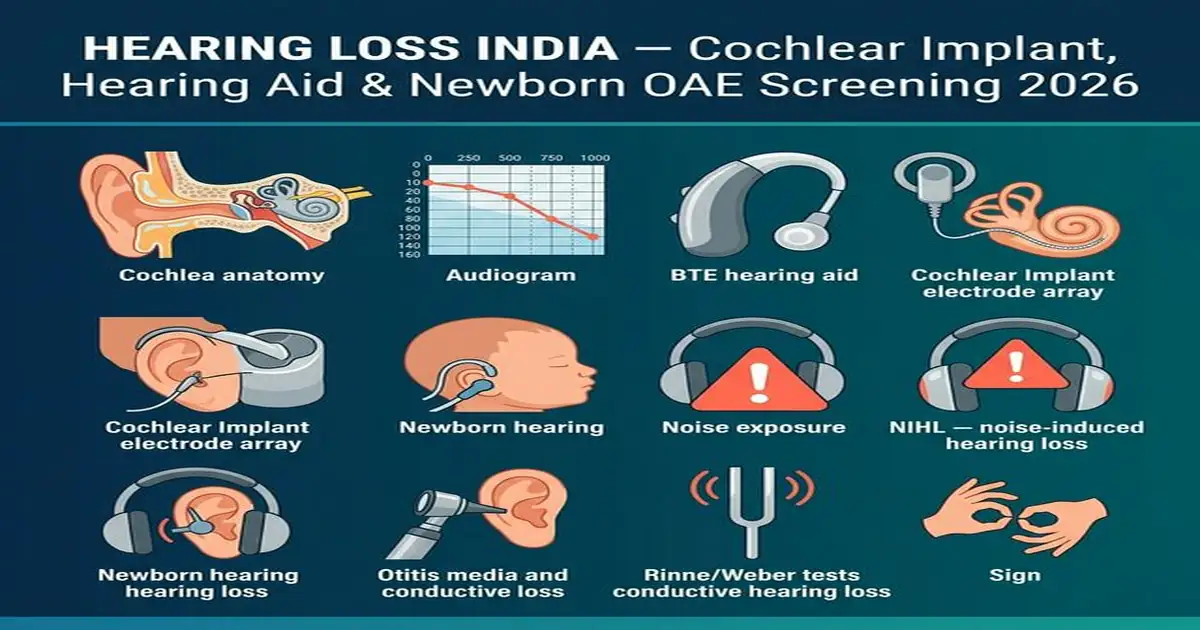
Hearing Loss India — Types, Diagnosis, Hearing Aids and Cochlear Implants
| Domain | Details | India Context |
|---|---|---|
| Types of Hearing Loss & Common Causes India | Classification by site of lesion: Conductive Hearing Loss (CHL): outer/middle ear; causes: wax impaction (cerumen); Otitis Media with Effusion (OME — “Glue Ear”): fluid in middle ear → most common acquired CHL in children (peak age 2–7 years); Chronic Suppurative Otitis Media (CSOM): chronic purulent ear discharge; may cause tympanic membrane perforation, ossicular erosion (persistent CHL), cholesteatoma (destructive keratinous lesion → erodes bone → CSOM with cholesteatoma = surgical emergency); Otosclerosis: abnormal bone growth at stapes footplate → progressive CHL in young adults (familial; prevalence higher in India than Europe); Sensorineural Hearing Loss (SNHL): cochlear (most common) or retrocochlear; Causes of SNHL: Presbycusis (age-related): progressive bilateral symmetric high-frequency SNHL from age 50+ (most common cause of adult hearing loss India — cochlear hair cell loss, vascular changes, strial degeneration); NIHL (Noise-Induced Hearing Loss): 4kHz notch on audiogram (C5 dip) — cochlear hair cell damage from sustained high-noise exposure — irreversible; Congenital (genetic or acquired): genetic: 50–60% of congenital profound hearing loss (connexin 26 GJB2 mutation — most common single gene — prevalent India); acquired: congenital rubella (now markedly reduced with MR vaccine), CMV (most common non-genetic congenital SNHL worldwide), hyperbilirubinaemia (kernicterus), birth asphyxia, ototoxic drugs in pregnancy; Ototoxic drugs: aminoglycosides (gentamicin — IV; streptomycin — anti-TB IM: both vestibulotoxic + cochleotoxic → bilateral SNHL + vertigo); cisplatin (chemotherapy); furosemide high-dose; quinine overdose; prolonged high-dose aspirin (salicylate toxicity); Meningitis sequelae: bacterial meningitis (Streptococcus pneumoniae — highest SNHL risk ~30%; H. influenzae; N. meningitidis); SNHL after meningitis typically bilateral profound; Mixed Hearing Loss: both CHL + SNHL components | India CSOM epidemic: CSOM is the most common ENT condition in Indian children — prevalence 6–17% in school-age children in endemic areas (coastal, rural — overcrowding, malnutrition, poor hygiene → repeated AOM → perforations → CSOM); CSOM is a preventable cause of CHL — repeated acute otitis media (AOM) treated inadequately → chronicity; India prevention: (1) pneumococcal vaccine (PCV13 — now in NIS), (2) grommets/ventilation tubes for OME if persistent ≥3 months with CHL, (3) tympanoplasty for CSOM TM perforation; Gentamicin/streptomycin ototoxicity India: extremely common → streptomycin use in TB (Category II regimens in pre-2019 RNTCP) → widespread bilateral vestibular toxicity + SNHL in TB-cured patients; baseline audiogram before starting aminoglycoside + monitoring (monitoring rarely done actually); ototoxicity monitoring in MDR-TB patients on amikacin/kanamycin — now replaced by bedaquiline/delamanid in NTEP India 2024 (milestone reducing ototoxicity exposure); NIHL India: Mumbai road traffic noise 85–95 dB; weaving industry (Surat, Varanasi); foundries (Ludhiana); firecrackers (Diwali): 120–160 dB — acute NIHL (temporary threshold shift → with repeated exposures → permanent); earphone/earbud use at high volume (>80 dB >8h/day → WHO-defined unsafe). |
| Diagnosis — Pure Tone Audiometry, Tympanometry & OAE | Clinical assessment: Tuning fork tests (512 Hz): Rinne test: BC > AC (bone conduction better than air conduction) = CHL; AC > BC = SNHL or normal (air conduction through cochlea works); Weber test: lateralises to BETTER ear in SNHL; lateralises to WORSE ear in CHL; Pure Tone Audiometry (PTA): gold standard diagnostic test for hearing; plots hearing threshold levels (HTL in dB HL) at frequencies 250Hz–8kHz for both ears (air conduction: headphone; bone conduction: mastoid vibrator); hearing threshold categories: Normal: <26 dB HL; Mild loss: 26–40 dB; Moderate: 41–60 dB; Moderately severe: 61–80 dB; Severe: 81–95 dB; Profound: ≥96 dB; Audiogram pattern: SNHL — high-frequency sloping loss (presbycusis — loses 4–8kHz first); CHL — flat loss with significant air-bone gap (>10 dB); mixed — both; NIHL — characteristic 4kHz notch; Tympanometry (immittance audiometry): measures middle ear pressure and compliance; Type A (normal peak): normal ME; Type B (flat/no peak): middle ear fluid (OME — glue ear); Type C (negative peak): Eustachian tube dysfunction; OAE (Otoacoustic Emissions): measures outer hair cell function; TEOAE (transient) or DPOAE; used for: newborn hearing screening (pass/refer in <5 minutes at bedside); monitoring ototoxicity; objective hearing function in infants; AABR (Automated Auditory Brainstem Response): for neonates who fail OAE screening → confirms SNHL; Behavioural testing: BOA (Behavioural Observation Audiometry), VRA (Visual Reinforcement Audiometry), Play Audiometry — for young children unable to cooperate with PTA; Speech audiometry: speech recognition threshold (SRT) + word recognition score (WRS) — important for hearing aid fitting and cochlear implant selection | India audiometry access: PTA: available at most ENT departments + private audiology clinics; cost: ₹500–2,000; tympanometry: ₹300–800; OAE machine: widely distributed under RBSK programme (all district hospitals, CHC); AABR machine: tertiary hospitals (AIIMS, KEM, CMC Vellore, Madras ENT Research Foundation); newborn OAE screening India: mandatory under RBSK for all live births at government facilities → “refer” result → repeat OAE at 1 month → if still refer → AABR at 3 months → if confirmed SNHL → hearing aid fit by 6 months (1-3-6 rule: identify by 1 month, diagnose by 3 months, intervene by 6 months); compliance with 1-3-6 rule in India: poor — most children reach ENT/audiology at age 2–3 years when language development window has already narrowed significantly; India aim: universal newborn hearing screening (UNHS) — fully implemented in <30% of facilities |
| Hearing Aids — Types, Selection & ADIP Scheme India | Hearing aid indications: moderate+ SNHL (>41 dB HTL in better ear at speech frequencies 500–4kHz); CHL not amenable to surgery (bilateral CSOM, otosclerosis patient refusing surgery); mild SNHL (26–40 dB) with functional difficulty; Types of hearing aids: BTE (Behind-The-Ear): most common; durable; suitable for all ages; power variants for profound loss; RIC/RITE (Receiver-In-Canal): smaller, better sound quality; suitable for mild-moderate loss; ITE (In-The-Ear): custom-fitted; cosmetically preferred; less robust; ITC/CIC/IIC (In-The-Canal/Completely-In-Canal/Invisible-In-Canal): premium cosmetic; limited power — only mild-moderate loss; BAHA (Bone-Anchored Hearing Aid): for CHL/mixed with chronic ear discharge (CSOM) or aural atresia — surgically implanted titanium post + external processor; hearing aid fitting process: PTA + speech audiometry → prescription (DSL v5 or NAL-NL2 prescriptive targets) + real ear measurement (REM — verifies amplification targets in individual ear) → programming → trial period (4–8 weeks) → review; Analog vs Digital: ALL modern hearing aids are digital (programmable, noise reduction, directional microphones, Bluetooth connectivity); Key features: background noise reduction; directional microphones; automatic programme switching; Bluetooth streaming (phone calls, TV — particularly useful for elderly India); rechargeable (eliminates battery-change problem — important for arthritic elderly); tinnitus masking programmes; Cost India: basic digital BTE government-approved (under ADIP): ₹500–2,000; mid-range digital (private): ₹15,000–40,000; premium BTE (Phonak Lumity, Oticon Real, Widex Moment): ₹70,000–200,000 per ear; ADIP Scheme (Assistance to Disabled Persons — MSJE): free hearing aids for BPL, SC/ST, disabled individuals; procurement through ALIMCO (Artificial Limbs Manufacturing Corporation of India, Kanpur — PSU); apply through DPO (District Persons with Disabilities Officer) or welfare office; also provided at ADIP camps at district hospitals; Cochlear Implant (CI) vs hearing aid: profound bilateral SNHL (>90 dB) not benefiting from hearing aid → CI candidate; moderate-severe SNHL with poor word recognition (WRS <50%) → CI candidate | India hearing aid gap: 63 million with hearing loss; only 1–2 million use hearing aids (<3% utilisation); barriers: cost (₹15,000–200,000 — catastrophic for rural poor); stigma (elderly refuse “old person device”); poor ear health literacy (“this is normal — everyone gets hard of hearing at 60”); poor audiology workforce (approximately 8,000 audiologists for 1.4 billion population); ADIP scheme delivery: very low reach — awareness abysmally low; many BPL families don’t know ADIP exists; new hearing aids Under NHM: GoI has expanded free digital hearing aid provision at district hospital level — gradually increasing; India-appropriate aids: ADIP BTE aids have recently been upgraded to digital (from analog 2022) — improvement in quality but still basic compared to premium; rechargeable BTE increasingly preferred India (no battery purchase burden); online fitting (tele-audiology): post-pandemic technology adopted at Shankar Netralaya, NIMHANS, Cochlear India — remote programming saves travel for rural patients |
| Cochlear Implants India — Candidacy, Surgery & PMJAY | Cochlear implant (CI): surgically implanted device that bypasses damaged hair cells → directly stimulates cochlear nerve → electronic hearing; components: internal (receiver/stimulator + electrode array — inserted into cochlea); external (sound processor worn behind ear + microphone + transmitter coil); MUST have intact cochlear nerve (retrocochlear) and functioning auditory cortex; Candidacy criteria: Adults: bilateral profound SNHL (≥90 dB PTA) with inadequate hearing aid benefit (WRS <50% in best-aided condition); Children: bilateral profound SNHL — ANY age >6 months; earlier = better (critical period plasticity); profound SNHL (≥90 dB) or severe SNHL with no/minimal hearing aid benefit; CI surgery: mastoidectomy + posterior tympanotomy + cochleostomy + electrode array insertion (under GA, 2–3 hours); complication rate: <1% serious; post-surgical activation: 4–6 weeks after surgery; rehabilitation: intensive auditory verbal therapy (AVT) — 2–4 sessions/week × 3–5 years (for congenitally deaf children); bilateral simultaneous CI: recommended wherever possible (better spatial hearing, better in noise) — cost barrier; CI in meningitis: URGENT — cochlear ossification begins weeks after meningitis → narrow window for implantation; Outcomes: congenitally deaf child implanted <12 months: 70–90% reach age-appropriate spoken language; implanted 3–5 years: 50–60%; implanted >5 years post-onset deafness: significantly reduced spoken language outcomes; adult implanted: meaningful benefit in all candidates — phone use in 70–80% | India CI programme: performed at 100+ centres nationwide (AIIMS Delhi, PGIMER Chandigarh, KEM Mumbai, CMC Vellore, NIMHANS Bangalore, Madras ENT Research Foundation, KIIT, Nair Hospital Mumbai, etc.); Cost: ₹6–8 lakh per implant (hardware) + ₹1–2 lakh surgery = ₹8–10 lakh per ear; PMJAY: cochlear implant for congenital profound hearing loss in children covered under PM-JAY health insurance package (limited seats/empanelled centres — enormous wait lists); Scheme for implementation of CISS (Cochlear Implant Support Scheme): ASSISTANCE under ADIP for implants — ₹6,00,000 per child for poorer families; state schemes: Karnataka CI scheme, Tamil Nadu CI scheme, Maharashtra CI scheme — free CI for economically weaker section children; CI outcomes India: studies from AIIMS, CMC Vellore, Nair Hospital indicate comparable outcomes to global standards when implanted early + intensive AVT provided; AVT (auditory verbal therapist) shortage India: severe — only 400+ certified AVT therapists for tens of thousands of CI users → outcomes limited by rehabilitation access; bilateral CI India: slowly expanding — PMJAY now considering bilateral coverage; Unilateral CI + contralateral hearing aid (“bimodal fitting”): standard for most India CI users (cost-driven) |
| NIHL Prevention & Presbycusis Management India | Noise-Induced Hearing Loss (NIHL) prevention: WHO-NIHL risk: sustained exposure ≥85 dB for ≥8 hours/day → cochlear hair cell damage → irreversible SNHL (4kHz notch classically); 85 dB = factory floor, heavy traffic, lawnmower; 100 dB = motorcycle without helmet (exhaust at rider’s ear), nightclub/concert; 110–120 dB = DJ/rock concert; 140–160 dB = firecrackers/gunshot; Engineering controls: soundproofing machinery; isolation of noise sources; Administrative controls: rotate workers in high-noise zones; reduce duration of exposure; Personal protective equipment: earplugs (disposable foam — NRR 25–30 dB; ₹5 each — most effective and cheapest); earmuffs (NRR 25–35 dB — for extreme noise: foundry, gunfire); custom canal plugs (audiologist-fitted — ₹5,000–15,000; for musicians, military); Listening safety: WHO “Make Listening Safe”: safe listening threshold: 80 dB for ≤40 hours/week; smartphone safe listening: 60% volume limit (60-60 rule: <60% volume for <60 minutes at a stretch); noise-cancelling headphones (reduce need for volume in noisy environments); Presbycusis (age-related hearing loss): progressive bilateral SNHL — affects 2/3 of adults above age 60; NOT inevitable to a disabling degree — depends on noise exposure history, genetics, cardiovascular health; Management: hearing aid (most important intervention): significantly reduces depression, cognitive decline, social isolation in elderly — recent ACHIEVE trial (2023): hearing aids reduced cognitive decline rate in high-risk elderly over 3 years; communication strategies: face speaker when talking; reduce background noise; clear speech (slow, face-to-face, no mumbling); written notes; Dementia link: Lancet Commission 2020: hearing loss = LARGEST single modifiable risk factor for dementia (accounts for 8% of dementia cases attributable risk); ACHIEVE trial 2023 (1 year RCT): hearing aid use → 48% reduction in cognitive decline in high-risk older adults (HL + no hearing aid use = accelerated dementia); universal message: treat hearing loss early → protect brain health | India NIHL scale: occupational NIHL: underreported severely — no systematic audiometric surveillance in most Indian factories; CPCB: 189 cities with noise pollution above 65 dB (limit); textile mills (Surat, Tiruppur, Ahmedabad) — shuttle looms 100–110 dB; Diwali crackers: India largest global fireworks manufacturer; temporary threshold shift after Diwali widespread in Delhi/Jaipur/Kolkata — permanent cumulative damage from childhood; hearing aid stigma India elderly: “wearing a hearing aid = shameful, old, disabled” — particularly in rural India; strategy: frame HA as “spectacles for your ears” rather than “hearing aid”; demonstrate benefit with trial — most elderly who try HA for 2 weeks refuse to return it; Audiologist India career: under-resourced; salary ₹25,000–60,000 at government hospitals; private sector better; AYJNISHD (Ali Yavar Jung National Institute of Speech and Hearing Disabilities, Mumbai): apex national institute for hearing rehabilitation — free evaluation, HA fitting, cochlear implant rehabilitation; regional centres (RCI-affiliated): nationwide |
Frequently Asked Questions
My baby failed the newborn hearing screening — what should I do next?
A “refer” result on a newborn hearing screening (OAE) is the most important early-warning signal a new parent can receive — and acting on it correctly within the first 6 months of life can make the difference between a child who develops age-appropriate spoken language and one who faces a lifetime of communication disability. Here is the complete step-by-step guide for Indian parents: Why the 1-3-6 Rule matters: The auditory cortex and language centres of the brain have a critical plasticity window — the neural connections that process sound and language are established most rapidly in the first 6 months and remain highly plastic until age 3; a child with profound hearing loss who begins wearing hearing aids by 6 months can often achieve normal spoken language; a child implanted with a cochlear implant by 12 months typically reaches age-appropriate language; a child not identified until age 3 has missed the period of maximum plasticity — outcomes are significantly poorer; WHO Universal Newborn Hearing Screening (UNHS) 1-3-6 rule: Identify (screen): by 1 month; Diagnose (confirm with AABR/PTA): by 3 months; Intervene (hearing aids or CI fitting + therapy): by 6 months. Step-by-step India action plan after OAE “refer”: Step 1 (by 1 month): Don’t panic — OAE fail does NOT confirm deafness; causes of OAE fail: vernix in ear canal, middle ear fluid from birth, ambient noise during test, temporary → repeat OAE (same hospital or nearest audiologist); Step 2 (by 3 months if repeat OAE fails): AABR (Automated Auditory Brainstem Response) — gold standard — confirms cochlear nerve function; AABR available at: AIIMS, KEM Mumbai, CMC Vellore, Madras ENT Research Foundation, NIMHANS, AYJNISHD Mumbai; if AABR also fails → schedule full diagnostic ABR under sleep/sedation → PTA when old enough; Step 3: CT scan/MRI of temporal bones (high-resolution CT + MRI IAC + brainstem): identifies cochlear abnormalities (common cavity, Mondini dysplasia, cochlear nerve hypoplasia — all affect CI candidacy and electrode design choices); Step 4 (by 6 months): Hearing aid fitting — even profound loss: fit BHA immediately → trial determines aided benefit; register under ADIP scheme (free hearing aid for BPL; ₹500–2,000); AYJNISHD (Mumbai) provides free complete evaluation + ADIP fitting; Step 5: Cochlear implant evaluation: if profound bilateral SNHL confirmed + hearing aid benefit inadequate → CI evaluation (PMJAY/ADIP/State scheme for eligible families); Step 6: Auditory Verbal Therapy (AVT): mandatory alongside CI/HA — immediate referral to speech-language pathologist + AVT therapist; AYJNISHD, Manovikas (Kolkata), Sampoorn (Mumbai) provide AVT; Step 7: RPWD disability certificate — obtain for school admissions advantages + legal rights (RPWD 2016: deafness listed disability → school accommodations, reservation); Sign language option: Indian Sign Language (ISL) — Indian government recognised ISL as official language of instruction (2023) → ISL teachers trained under ADIP/NISH; ISL + spoken language (bi-bi approach) → optimal outcomes for all deaf children.
Are earphones and earbuds destroying my hearing — and how loud is too loud?
The global epidemic of youth hearing loss from recreational noise exposure is one of the fastest-growing public health crises in audiology — and India is at particular risk given the combination of urban noise pollution, Diwali firecrackers, and the explosion of earphone/earbud use among 15–35-year-olds: The biology of noise-induced cochlear damage: The cochlea contains approximately 15,000 outer hair cells (OHC) — delicate sensory cells that amplify and tune sound signals → these cells DO NOT regenerate once destroyed (unlike most cells in the body — mammalian cochlear hair cells are terminally differentiated post-birth; some reptiles can regenerate cochlear hair cells — hence research interest in hair cell regeneration therapy); intense noise → metabolic exhaustion of OHC → free radical oxidative damage → OHC death → permanent SNHL; pattern: NIHL first damages 4kHz region (C5 dip on audiogram — corresponding to “cochlear resonance point” at ~4kHz where tuning is finest + most vulnerable) → extends to 6kHz, 3kHz with continued exposure; speech frequencies primarily affected later (2–1kHz); by the time NIHL “is noticed” as difficulty understanding speech in noise → major permanent damage already done; early NIHL is silent — patients do not notice 4kHz loss (not needed for everyday speech) until social noise environments become difficult; How loud is too loud — evidence-based thresholds: WHO/ITU recommendation: 80 dB for ≤40 hours per week is considered safe for lifetime cochlear health; NIOSH (USA): 85 dB for 8 hours with halving time of 3 dB per doubling of intensity (85 dB/8h = 88 dB/4h = 91 dB/2h = 94 dB/1h = 97 dB/30 min); typical earbud use India: most smartphones produce 85–110 dB at maximum volume; 60% volume on most phones = approximately 75–80 dB (safe); 80% volume = approximately 90–100 dB (unsafe within 1h); Practical guidelines India — “Make Listening Safe” rules: 60-60 rule: maximum 60% volume; maximum 60 minutes uninterrupted; then break; Noise-cancelling headphones (ANC — Active Noise Cancellation): premium (Sony WH-1000XM5, Bose QuietComfort 45, Apple AirPods Pro) reduce ambient noise 20–30 dB → allows lower volume for same perceived clarity → safest headphone category; In-ear vs over-ear: in-ear (earbuds) canal — when properly fitted, seal the canal well — can be safe at lower volumes; poor-fitting earbuds → audio leakage → user turns up volume to compensate → unsafe; Diwali crackers India — CRITICAL: 120–160 dB at point of explosion → single exposure can cause permanent threshold shift; safe distance from cracker: minimum 4 metres for standard crackers; foam earplugs + maintain distance = essential during Diwali celebrations; children — absolute prohibition from lighting or holding crackers; noise-induced tinnitus: ringing after concert, club, Diwali = TTS (temporary threshold shift = cochlear stressed but not irreversibly damaged) → warning sign → if ringing persists >24 hours → audiologist review → tinnitus with NIHL pattern → reduce noise exposure immediately; Tinnitus management India: 15–20% of Indian adults have chronic tinnitus; no cure; management: tinnitus retraining therapy (TRT), sound therapy (white noise generators), CBT for tinnitus distress; masking (hearing aid with tinnitus masking feature); AVOID: benzodiazepines for tinnitus (highly addictive; no evidence; dependency India common).
What to Read Next
- Autism & Hearing — Distinguish ASD (no name-response but normal OAE) from Deafness (no name-response + abnormal OAE/AABR); Both Need Early Specialist Assessment
- Dementia — Lancet 2020: Hearing Loss = Largest Modifiable Dementia Risk; ACHIEVE Trial 2023: HA Use Reduces Cognitive Decline 48% in High-Risk Elderly; Screen + Treat
- Depression & Hearing Loss — Social Isolation from Untreated HL → Depression; Hearing Aid Reduces Loneliness Index; Elderly HL + Depression = Treatable Combination
- TB & Ototoxicity — Streptomycin IM (Cat II) → Vestibulotoxic + Cochleotoxic; Amikacin in DR-TB; Bedaquiline-Based NTEP Regimen Reduces Ototoxicity Burden
- Diabetes & Hearing — DM Increases SNHL Risk 2× (microvascular cochlear damage); Annual Audiogram for Diabetics Ototoxic Drug Monitoring; Presbycusis Earlier in DM
A 2-year-old girl from rural Karnataka — brought for “not talking” at 24 months. Her parents assumed she was “slow” — several relatives also “talked late.” OAE: bilateral refer at birth (government hospital — result not communicated to parents). AABR now: bilateral profound SNHL (90+ dB). CT: normal cochleae. Diagnosis: bilateral profound SNHL — likely congenital genetic (GJB2 connexin 26 — most common cause). PMJAY application submitted for CI. Hearing aids fitted immediately (ADIP scheme — free). AVT started. CI surgery at 26 months (just within widened critical window). At 5 years: she is in an inclusive mainstream school with a resource teacher. Her teacher says her spoken language is near grade-appropriate. Her mother: “At birth, there was a paper that said ‘REFER’ for hearing. We didn’t know what it meant. No one explained it to us.” The paper contained her daughter’s future. A single conversation at discharge — “Your baby needs a follow-up hearing test in 1 month” — would have changed two years.
About This Guide: Written by the StudyHub Health Editorial Team (studyhub.net.in) based on WHO World Report on Hearing 2021, AYJNISHD India Hearing Screening Guidelines, JCIH (Joint Committee on Infant Hearing) 2019 Position Statement, Lancet Commission Dementia 2020, ACHIEVE Trial 2023, and NTEP India Guidelines 2024. Last updated: March 2026.
👂 Baby Failed OAE Hearing Screen? Act Within 3 Months: An OAE “refer” result at birth means your baby needs a follow-up hearing assessment. Repeat OAE at 1 month → if refer again → AABR by 3 months. Confirm hearing aids fitted by 6 months — even for profound loss. This 1-3-6 rule protects language development. Free hearing aids: ADIP scheme (apply via District Disability Officer). Cochlear implant: covered by PMJAY + state schemes. AYJNISHD Mumbai: free complete evaluation.
🎧 Earbuds at High Volume Are Damaging Your Hearing Permanently: Cochlear hair cells do NOT regenerate. NIHL is irreversible. Follow the 60-60 rule: max 60% phone volume, max 60 minutes uninterrupted. Ringing after concerts or Diwali = warning sign. Use noise-cancelling headphones to listen safely at lower volumes. Diwali crackers: minimum 4m distance + foam earplugs for adults; zero crackers for children.
⚕️ Medical Disclaimer: This article provides general educational information about hearing loss. All audiological assessment, hearing aid prescription and fitting, cochlear implant candidacy evaluation, and auditory verbal therapy require qualified audiologist and ENT surgeon assessment. AYJNISHD Mumbai provides free government services.