
Composition of Extra Peninsula Extrapeninsular India
Extra Peninsula comprises the Himalayas in the North, Arakan Yoma in the East, and foredeep folded beds also known as Shiwaliks or Outer Himalayas in the South. The Himalaya sensu stricto represents the large orogenic belt that covers a length of 2500 km and a width of 300-400 km.
They are bounded by the syntaxes or knee-bends of Nanga Parbat (3126 m) in the West and Namche Parbat (7256 m) in the East. Westward of the Nanga Parbat syntaxis, the extensions of Himalaya are seen along the Sulaiman and Kirthar ranges of Pakistan, ending against the Arabian Sea and covering a total length of 5200 km.
Boundaries and Physiography
- Northern Boundary: Marked by the Brahmaputra.
- Southern Boundary: Marked by Indo-Gangetic plains.
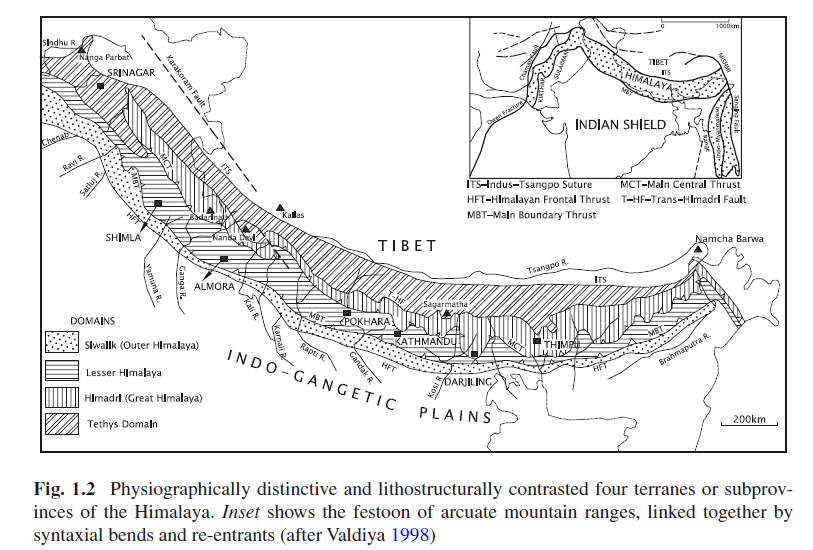
The NW-SE-trending 2500-km-long and 300-400-km-wide expanse of the main Himalaya embodies four physiographically contrasted and lithostructurally distinctive terranes, particularly in the stretch between the Ravi in the west and the Arunachal in the east.
Four Physiographic and Lithostructural Terranes (South to North)
- The Siwaliks (Sub-Himalayas, Outer Himalayas)
- The Himachal (Lesser Himalaya, Lower Himalayas)
- The Himadri (Greater Himalayas, Crystalline Himalayas)
- The Tethys Himalaya
Lithotectonic Divisions of the Himalayas
1. Sub-Himalaya or Outer Himalaya (Siwalik Terrane)
- Consisting of molasse sediments (18 to 1 Ma) exposed in the Siwalik Hills (250-800 m thick), together with their intermontane valleys called the duns (e.g., Dehra Dun).
- The molasse sediments form an apron of gravelly debris in the middle called the Bhabar.
- The Outer Himalaya is bounded to the south by the Himalayan Frontal Thrust (HFT), separating it from the vast Holocene Indo-Gangetic Alluvium of the Sindhu-Ganga Trough.
2. Lesser Himalayas
- Overthrusts the Lower Himalayas in the south along the Main Boundary Thrust (MBT).
- The Lesser Himalaya has an undulating landscape in the middle and mountainous terrain on the sides like the Pir Panjal and Dauladhar ranges (3500 m) in Kashmir and Mahabharat Hills (3000m) in Nepal.
- This zone contains Palaeoproterozoic (~1800 Ma) and lower Palaeozoic (~500 Ma) sediments, some of which are metamorphosed up to greenschist facies.
- This zone also contains cappings of Tertiary sediments, nappes, and klippen of metamorphic rocks (2200 to 1800 Ma), and Pan-African granitic intrusions (~550 Ma).
3. Higher or Greater Himalaya (Himadri)
- Higher or Greater Himalayas are separated from the Lesser Himalayas in the south by the Main Central Thrust (MCT).
- The Higher Himalaya with its high rugged scarps (3000 to 8000m) consists of Central Crystallines representing the metamorphic core, affected by intense ductile deformation and extensive migmatisation.
- The Central Crystallines (2200-1800 Ma, 500-550 Ma, ~20 Ma) consist of a 10-15 km thick assemblage of mica schists, quartzites, calc-silicate rocks, paragneisses, orthogneisses, migmatites, and Miocene leucogranites.
4. Tethyan or Tibetan Himalaya
- Tethyan or Tibetan Himalayas are Separated from the Higher Himalayas by low-angle normal faults called the South Tibetan detachment system, which parallels the MCT and dips to the north. It is also called the Trans-Himadri Thrust.
- The Tethyan Himalaya has a 10-17 m thick succession of highly fossiliferous marine sediments of Neoproterozoic (~600 Ma) to Eocene (~65 Ma) ages.
- The sediments are largely un-metamorphosed and occupy synclinal basins to the south of the famous Indus Tsangpo Suture Zone.
- The Tethyan Himalaya is bounded by the 50-60 m wide Trans-Himalayan Indus-Tsangpo Suture Zone in the north. The suture zone occurs along the valleys of The Indus and Tsangpo Rivers. It consists of deep-sea flysch sediments, blueschists, and ophiolite mélange of the lost Tethys Ocean. This suture is also called the Main Mantle Thrust.
- In the western Himalayas, a second suture occurs further north called the Shyok Suture Zone which is associated with the Main Karakorum Fault.
5. Trans-Himalayan Batholiths
- Comprising Karakorum, Ladakh, and Kailas Mansarovar, forming a large linear plutonic complex of I-type plutons (gabbro-diorite-granite) ranging in age from 110 to 40 Ma. This occurs to the north of the Indus-Tsangpo and Shyok suture zones.
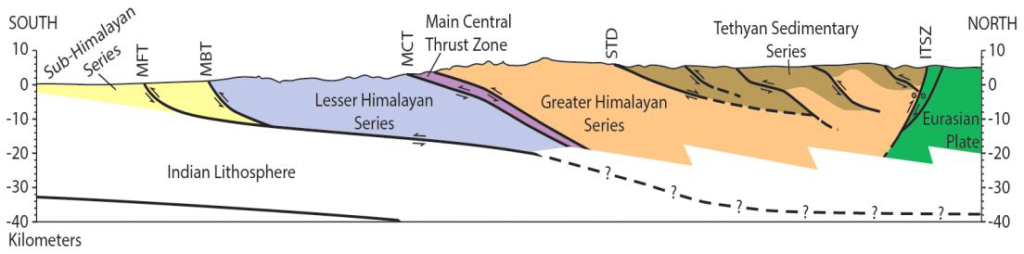
Simplified Cross-section of Himalaya
| Thrust Zone | Associated Features |
| Main Karakorum Thrust | Shyok Suture Zone, Karakorum-Ladakh Zone |
| Main Mantle Thrust | Indus-Tsangpo Suture, Tethyan Himalaya |
| Trans-Himadri Thrust, Martoli Fault, Zanskar Fault | Higher Himalaya |
| Main Central Thrust (MCT), Vaikrita Thrust | Lesser Himalaya |
| Murree Thrust, Krol Thrust, MBT-I | Murree Formation |
| Main Boundary Thrust, MBT-II | Siwalik Group |
| Himalayan Frontal Thrust | Indo-Gangetic Alluvium |
Precambrian of the Himalayas
- The Precambrian sequences of the Himalaya are exposed mainly in the Lesser and Higher Himalaya and to a lesser extent in the Tethyan Himalaya and Trans-Himalaya.
- The stratigraphy is complicated by the lack of fossils in the Precambrian and Phanerozoic un-metamorphosed sections, disruption by large-scale faults and thrusts, overprinting by Himalayan orogeny involving Tertiary metamorphism and granitic intrusions, and lack of adequate radiometric ages.
- The Geological Survey of India has divided the lithostratigraphy into eleven sedimentary cycles. Out of these, Cycles I to IV (First to Fourth Cycles) pertain to the Precambrian.
- Extending from Palaeoproterozoic to the Eocambrian (GSI, 1989).
- There are no recognisable Archaean elements in the Himalaya, and so its early history commences with the Palaeoproterozoic basement of the Indian shield.
- The Precambrian stratigraphic description of the Himalaya is organized here according to sedimentary cycles belonging to different tectonic zones (like the Lesser and Higher Himalaya), and categorized into geographic regions in the Western, Central, and Eastern Himalaya.
Composite lithostratigraphy of the First Cycle(1800-2250Ma)
| Composite lithostratigraphy of the First Cycle(1800-2250Ma) |
| Intercalated quartzite, mica schist, marble, calc-silicate rock, metabasic rock, biotite gneiss and younger granite (chlorite to biotite grade) |
| Mica schist, quartzite, migmatitic biotite gneiss, granitic gneiss and basic sills (biotite grade) |
| Garnet-mica schist, quartzite, calc-silicate rock, banded and augen gneiss (garnet grade) |
| Kyanite schist, garnet-biotite-staurolite schist and quartzite, biotite gneiss (staurolite-kyanite grade) |
| Sillimanite-muscovite-K-feldspar gneiss (sillimanite grade) |
Composite lithostratigraphy of the Second Cycle
| Lithostratigraphy | Location |
|---|---|
| Quartzite with siltstone and slate | Kalamund (Kashmir) |
| Carbonate sequence with stromatolitic dolomite, phyllite | Shali, Deoban (H.F.) |
| Limestone, phosphorite, magnesite, quartzite | Gangolihat (Kumaun) |
| Quartzite with penecontemporaneous flows of spilite-keratophyre, phyllite | Mandi, Banjar (H.P.) |
| Carbonaceous phyllite, quartzite, metavolcanic, and marble | Tenga Formation (Arunachal) |
Composite lithostratigraphy of the Third Cycle
| Jaunsar and Shimla Groups |
| Quartz arenite, quartz wacke, slate and rare conglomerate |
| Quartz arenite interbedded with slate and rare metabasalts |
| Shale-siltstone alternations with algal limestone |
| Limestone, shale, quartz arenite and boulder bed |
Generalized Stratigraphy of Fourth Cycle
| Krol Group | Calcareous sandstone, quartz arenite, dolomite, limestone, phosphatic chert, black shale, rare conglomerate | |
| Shale, dolomite, gypsum lenses, oolitic limestone | ||
| Krol Sandstone | Quartz arenite with fragments of phosphatic shale | |
| Infra Krol | Black shale, slate, slaty quartzite | |
| Blaini Group | Shale and interbedded dolomitic limestone | |
| Boulder bed with clasts of earlier sediments in a variable matrix | ||
| Shale, slate, quartzite, varved argillite, and rare conglomerate | ||
| Boulder bed with assorted clasts and variable matrix |
Precambrian Tethyan Succession
- The Salkhala Group in North Western Himalaya (J and K): Contains mainly schist, slates, quartzites, phyllites, etc., overlain by Dogra slates of Early Cambrian to Late Neoproterozoic.
- The Vaikrita Group in the Spiti Region of Himachal Pradesh: Made up of mica-schist, talc-schist, and phyllites, overlain by Haimanta Group (Upper Proterozoic-Cambrian).
- Jutogh Group in Shimla: Intruded by Chor Granite of Paleozoic age.
- Daling Group in Darjeeling: Various lithologies.
- Bhimpedi Group in Nepal: Various lithologies.
Precambrian of Lesser Himalayas
Western Sector
- Jammu Limestone: Also known as Great Limestone or Riasi Limestone, overlain by Subathu formation of Paleocene-Eocene age.
- Shali-Shimla Group: Various lithologies.
| Lithostratigraphic Classification of the Simla Group (after Srikantia and Sharma, 1971) | ||
| Formations | Lithology | Thickness in metres |
| Sanjauli Formation | Upper : Conglomerate, arkoses sandstone, shale | 1600 |
| Lower: Greywacke, shale & siltstone, orthoquartzite | ||
| Chaosa Formation | Shale, siltstone, greywacke, orthoquartzite | 1300 |
| Kuniha Formation | Shale, siltstone with limestone interbeds | 450 |
| Basantpur Formation | Bedded & massive limestone, shale and siltstone and a basal greyish white quartzite and conglomerate | 1000 |
| Disconformity | ||
| SHALI GROUP | ||
Central Sector
- Kumaon-Garhwal Region: Various lithologies.
| Lithological Succession of the Inner Autochthonous Zone of the Kumaun Himalaya (after Valdiya, 1980) | |||
| Group | Formation | Lithology | Thickness in metres |
| Sirmur Group (Palaeogene) | |||
| Unconformity | |||
| Tejam Group | Mandhali Formation | Carbonaceous, pyritic phyllites, limestones and conglomerate | More than 2500 |
| Deoban Formation | Stromatolitic cherty limestones & slates | 1200 | |
| Sharp break in facies | |||
| Rautgraha Formation | Quartzites, slates with volcanic flows | 2000 | |
| Damatha Group | Chakrata Formation | Greywackes, siltstones, and shales | More than 2000 |
| Base not exposed | |||




















5 thoughts on “Precambrian of Extrapeninsular India: Stratigraphy of india”
Very best content
please can you give me science and technology current affair
You rocked this subject and have astounding insights. I also work hard in putting together great content about Airport Transfer, feel free to visit UQ9
Superb posts! Have a look at my page Article City where I also put in extra effort to create quality information about SEO.
Hey, I enjoyed reading your posts! You have great ideas. Are you looking to get resources about Car Purchase or some new insights? If so, check out my website QH5